Use Time
Or It Will Use You.

Use Time is a companion to R. Geoff Dromey's Use Time Or It Will Use You time-management book. The app brings Dromey's practice to life, guiding the user to plan their time around the four pillars as they progress through days, weeks and months towards attaining their long-term goals.

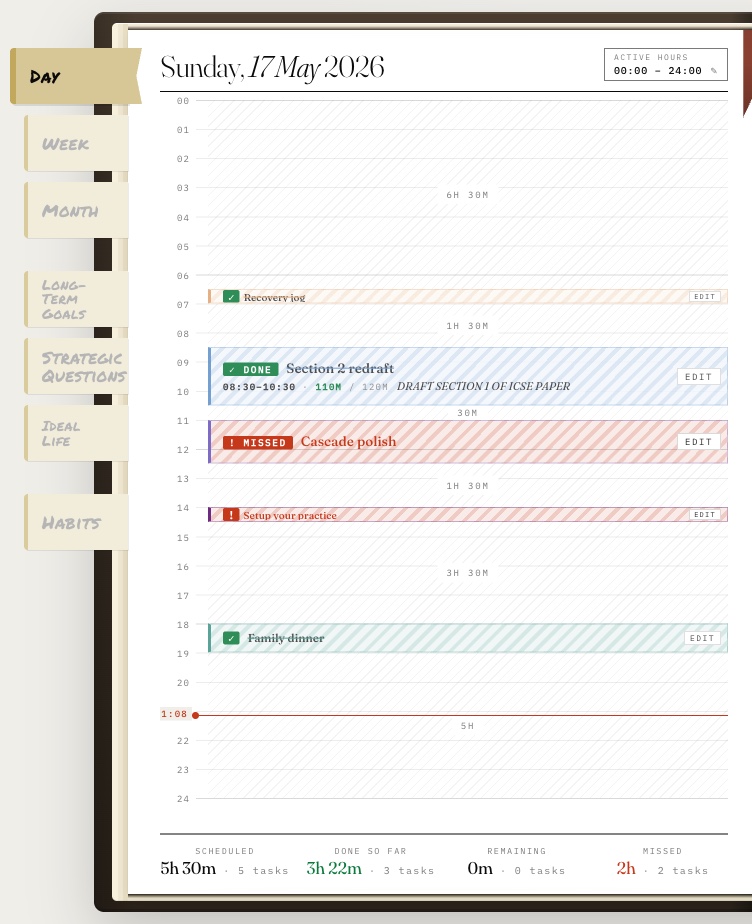
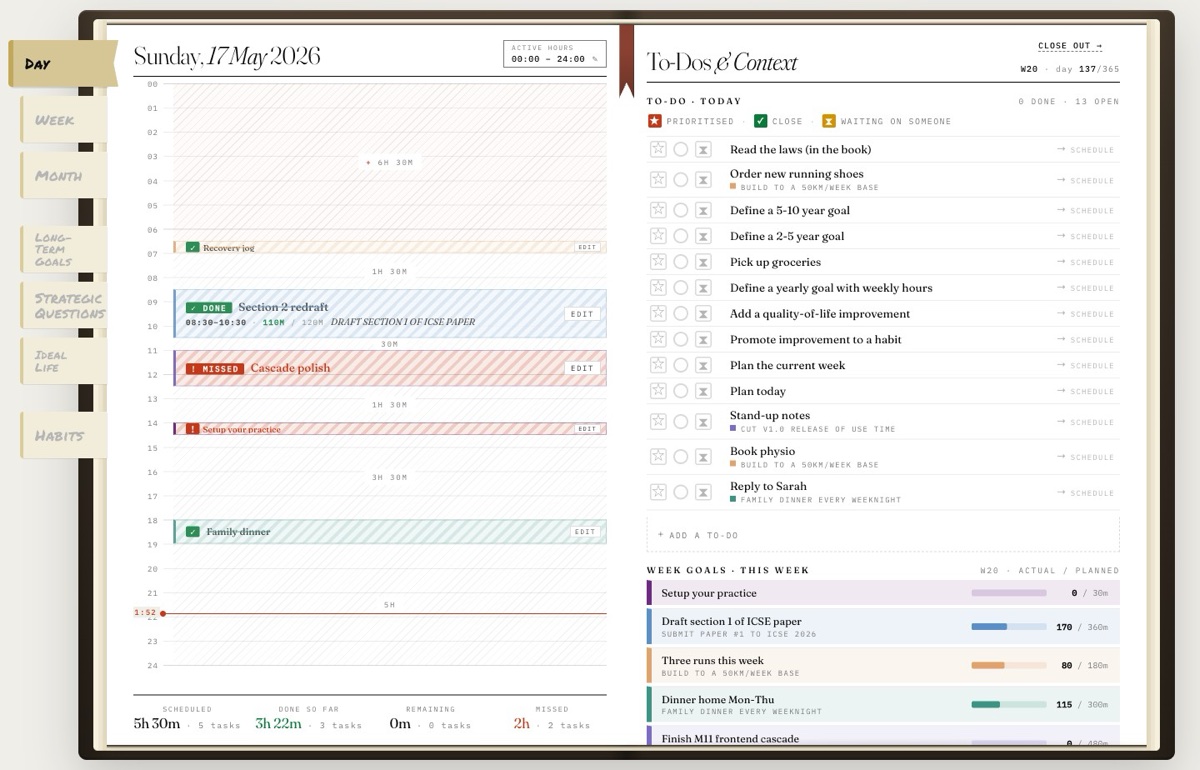
The Use Time app's day view — an open book with sticky-note navigation tabs down the left edge and a timed calendar from midnight to midnight with the day's work scheduled in coloured blocks.
The day view — Use Time

A companion, not a substitute.

§ 01 · The source
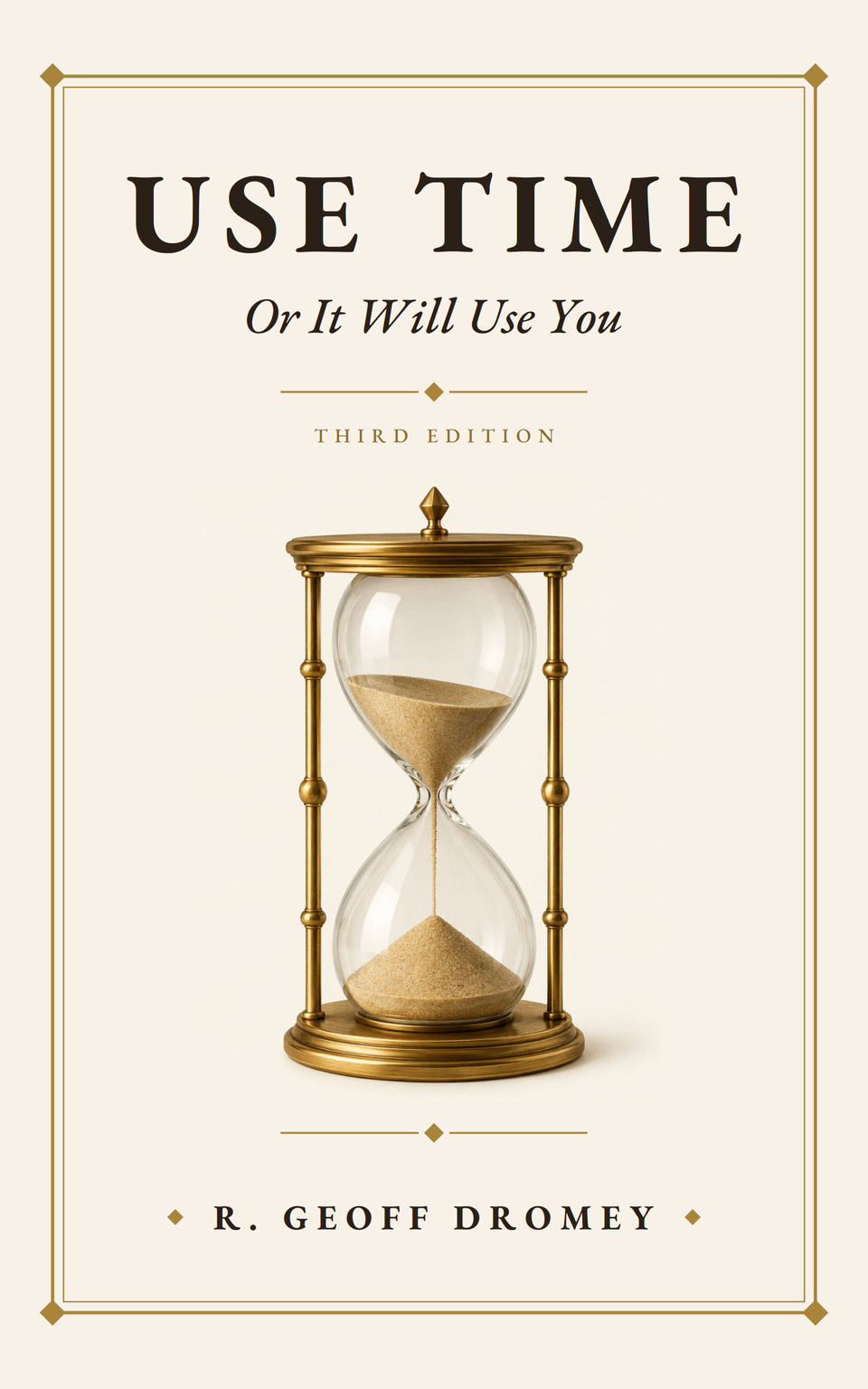
About the book
Second edition · 2012
Use Time
or it will use you
R. Geoff Dromey

The book teaches you to invest your hours in what you'll be glad you invested them in — to protect time for your long-term goals, keep all four pillars of a life in balance, and close each week with something that lasts.

Dromey kept the methodology alive in a set of weekly worksheets he rebuilt week after week. The app lives in that same place — holding your worksheets, running the cadences on schedule, keeping your reflections in one quiet home — so the practice itself is easier to stay with. The thinking still comes from the pages. You'll want a copy near you.

Four pillars, one budget of hours.

§ 02 · Quality of life
The model

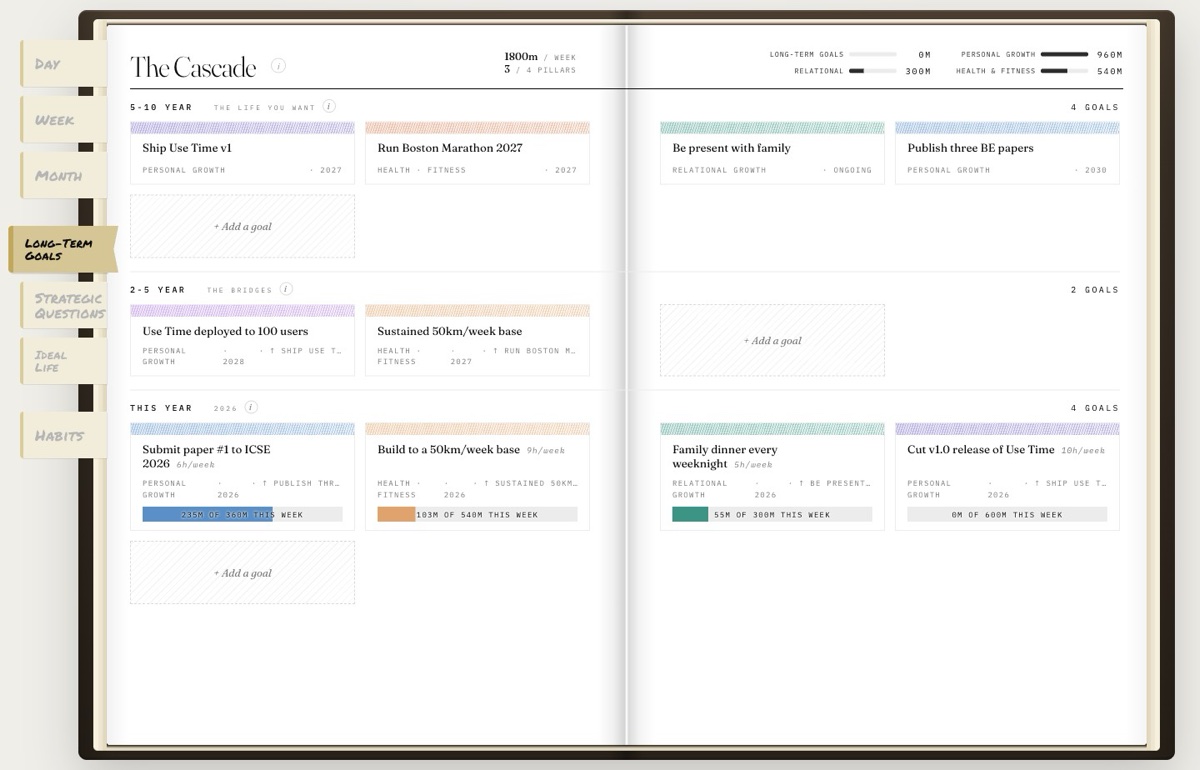
Every goal, every block of time belongs to one of the four sides of the Quality-of-Life Tetrahedron. The app keeps that mapping in front of you — so the balance across the four is something you can see, not guess.

I
Long-term goals
≥ 6 months out. Up to four can run in parallel — two is the book's sweet spot. The app flags a week when quality minutes fall short of your commitment.
II
Personal growth
Reading, learning, reflection — your own development, no matter the circumstances.
III
Relational growth
Partner, children, parents, friends — time given with undivided attention.
IV
Health &
fitness
Exercise, sleep, diet — carried by habits and daily items.
Long-term goals Health &fitness Relationalgrowth Personal growth

Four cadences, nested.

§ 03 · Rhythm
Close · then plan

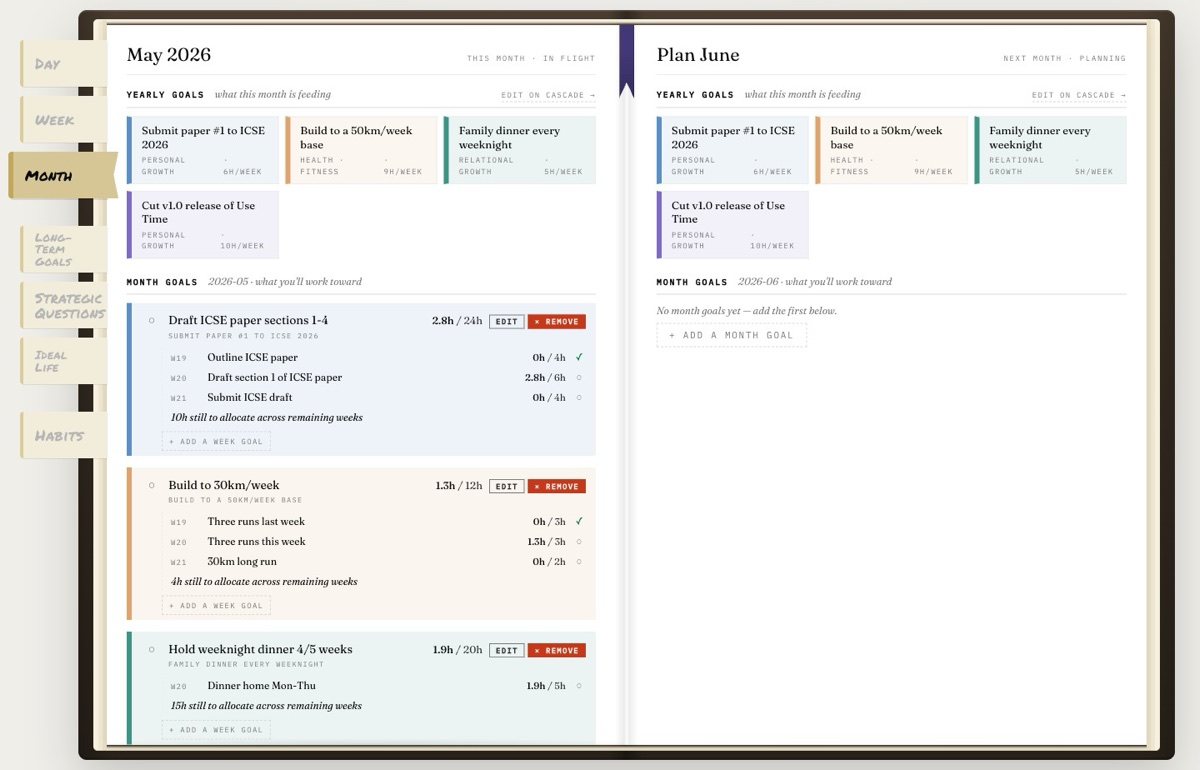
Three time-horizon cadences plus a discretionary one for habits. Each has the same shape — close the period you are leaving, plan the one you are entering — and outcomes cascade upward: daily into weekly, weekly into monthly, monthly into the year.

§ 01 · Close & Plan
Daily
Every evening · ~10m
Close today, compose tomorrow.
Mark day items done / partial / skipped. Write one retrospective line. Compose tomorrow — up to three major tasks.
§ 02 · Close & Plan
Weekly
Sunday evening · ~30m
Review the week, commit the next.
Rollover, release, or push forward each incomplete goal. Set the weekly time budget per long-term goal.
§ 03 · Close & Plan
Monthly
Last day · ~30m
Carry the month up into the year.
Month's outcome cascades into the year. Next month inherits from the current year. Long-term-goal time-invested rolls into the quarterly and yearly buckets automatically.
§ 04 · Review & Revise
Habit audit
Every ~3 months · ~15m
Revise the habit set.
Discretionary. Add, deactivate, retire habits. An improvement that has taken hold can graduate to a habit here.
Outcomes propagate without you writing reports.
When you mark a day item done, the actual minutes flow into the linked week goal and into the long-term goal's weekly, monthly, quarterly, and yearly time-invested totals. It updates automatically — and reverses cleanly when you change a mark.

A method with laws.

§ 04 · Methodology
Twenty-six laws

Dromey's method is unusually concrete. Across two chapters it sets out twenty-six laws — eleven for investing time, fifteen for using it well — naming what most time-management advice leaves unsaid. The app honours them quietly, and trusts you with the rest.

11 Laws of Time Investment

A small number of things, chosen well.

The app asks you to commit to long-term goals in a considered way, and makes that commitment visible each time you plan a week. When the shape of where your time goes drifts from what you said mattered, you see it — quietly, in your own plan.

15 Laws of Time Utilization

Focus, protected. Weeks, closed.

Deep sessions are counted differently from busy ones. Every cadence ends with a written reflection before the next one opens. No streaks, no nudges — just the honest shape of the week, held for you.
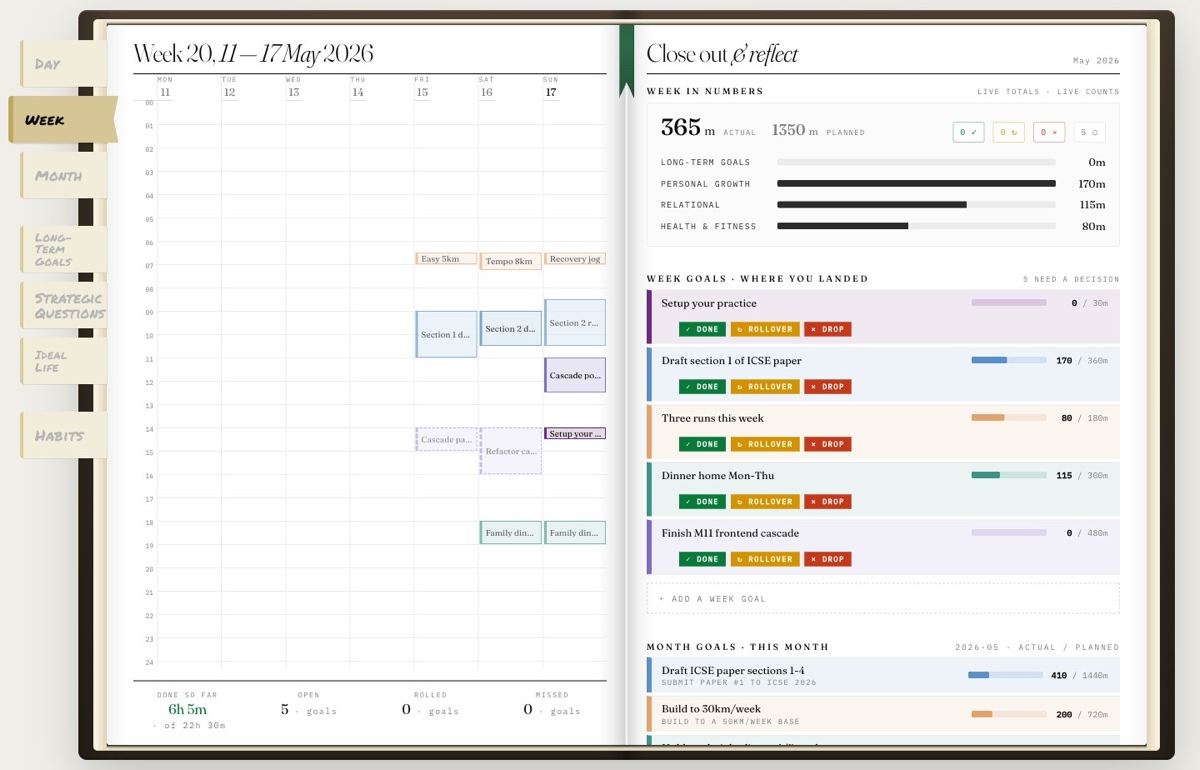
From the app, four pages.

§ 05 · Live preview
Auto-advancing

Get started.

§ 06 · Open registration
A guided first week

You won't start at a blank page. Your first week comes set up for you — seven short steps that take you from naming your long-term goals to a planned, workable first week.

Before you ask.

§ 07 · Questions
Answered honestly
You can use the app without having read it, but the app is a companion — it holds the cadences and worksheets; it does not teach the method. It is built to sit next to a copy of Use Time Or It Will Use You, open on the relevant page.
No. R. Geoff Dromey passed away in 2009. The app is built by a reader, in tribute — it is unofficial, and not affiliated with his estate.
Click create account. You'll get a verification email; click the link to start. Free during the open beta.
Free while we work out whether the app finds an audience. If a hosted plan eventually has a price, existing accounts will get fair notice and a reasonable grace period.
Stored in our database, scoped to your account. We don't sell or share data, and there are no third-party trackers on the app itself.
Anyone who wants to be intentional about where their time goes — making steady progress on long-term goals while keeping health, relationships and personal growth in balance. Reading the book alongside helps, but it isn't required.